We built an AI-powered credit risk scorecard that fuses trade-credit signals, rating-agency intelligence, and real-time news into a single underwriting view — so a credit analyst can see, understand, and defend a limit recommendation in under a minute.
A commercial credit team was extending terms to hundreds of accounts. The data existed — trade experiences, rating agency reports, payment aging, public news — but lived in a half-dozen systems.
An analyst opening a file saw raw numbers. The reasoning that connects those numbers to a limit recommendation happened inside someone's head, on a scratch pad, or in a review meeting. Decisions were defensible but slow, inconsistent across analysts, and almost impossible to audit months later.
Worse, the signals that actually mattered most — a rating agency downgrade, a sudden past-due spike, a news report about an unsustainable capital structure — were the hardest to surface. They arrived after the limit had already been set.
The team didn't need a new database. They needed a decision surface: a single page that shows every relevant signal, weighs it, explains itself, and proposes a limit an analyst can accept, adjust, or override.
Give a credit analyst one page, per account, where the suggested limit, the reasoning behind it, the scenarios around it, and the evidence supporting it all live together — and make it fast enough to review the entire book in a morning.
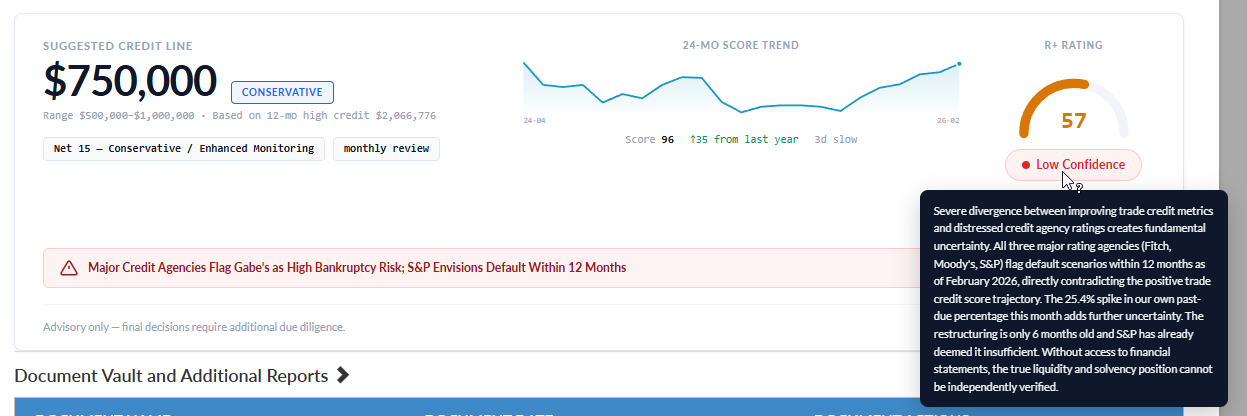
Every account rolls up to a scorecard with a recommended credit line, a confidence-adjusted rating, and four drill-downs that explain exactly how the system got there.
A single suggested credit line with a range, a confidence indicator, and the headline reason — visible above the fold, alongside a 24-month score trend.
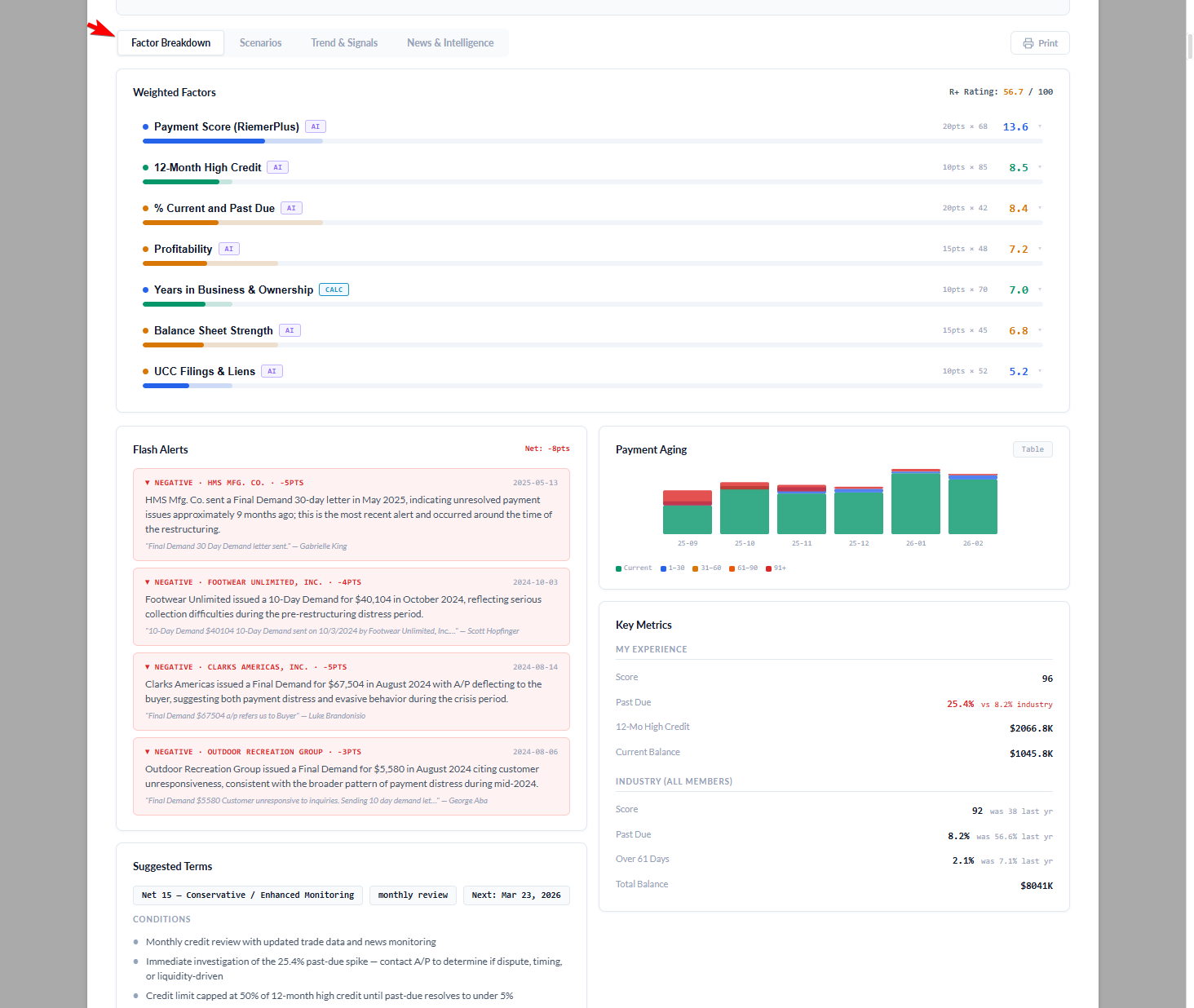
Seven weighted factors — payment score, 12-month high credit, past-due, profitability, tenure, balance sheet strength, UCC filings — each with its own AI-generated analysis and optional manual override.
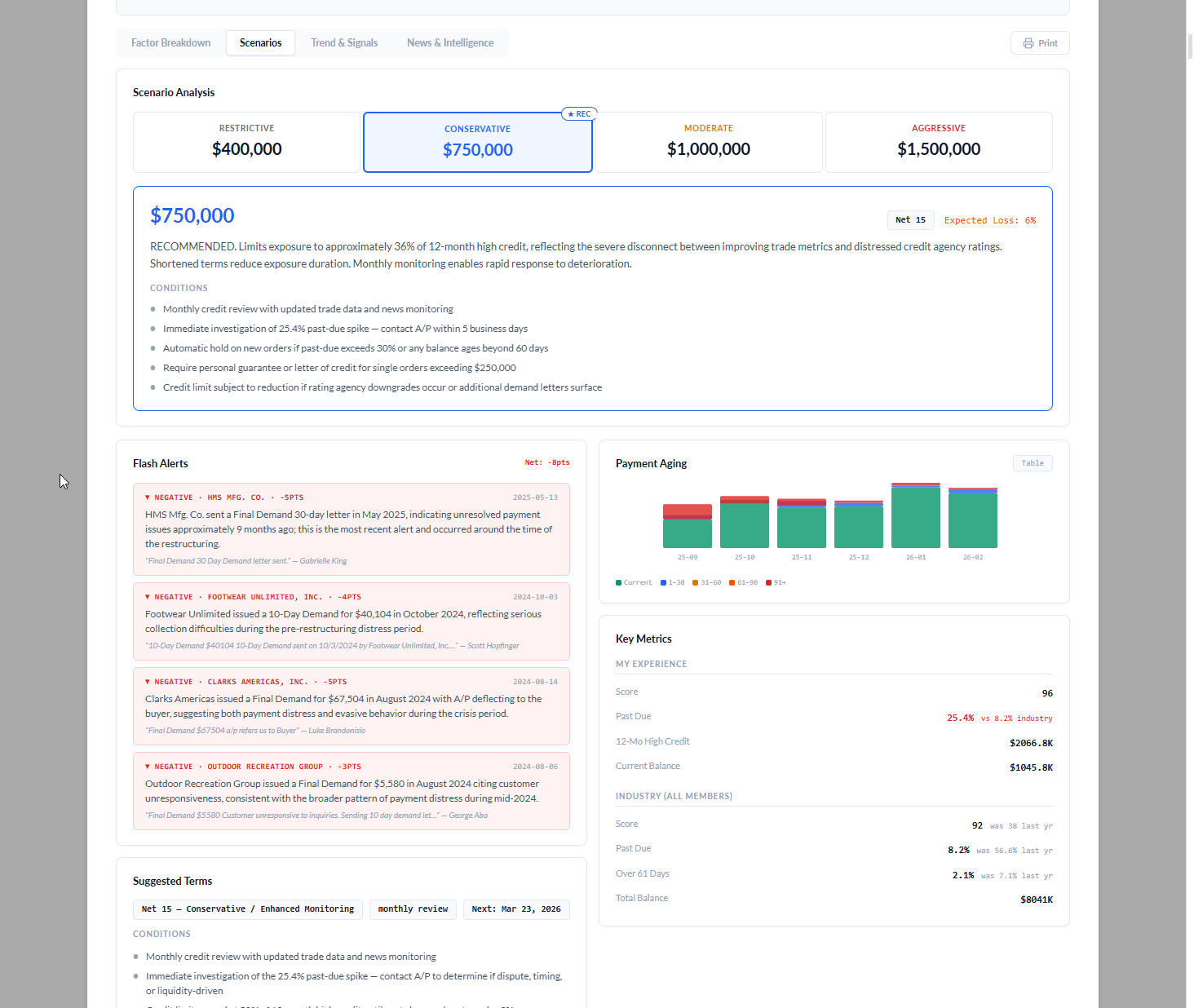
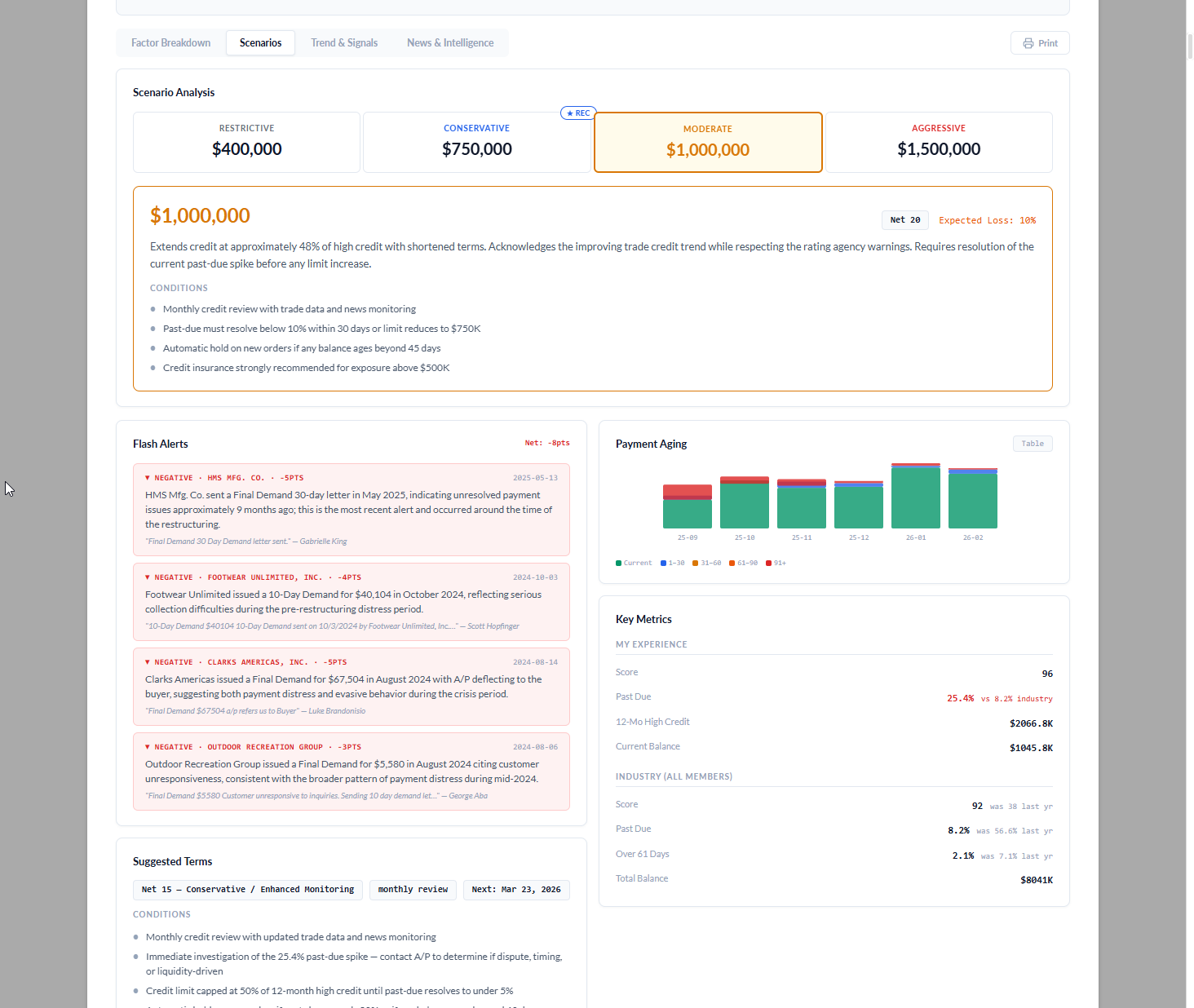
Four pre-modeled scenarios (Restrictive, Conservative, Moderate, Aggressive) with dollar limits, expected loss estimates, and the specific conditions each requires.
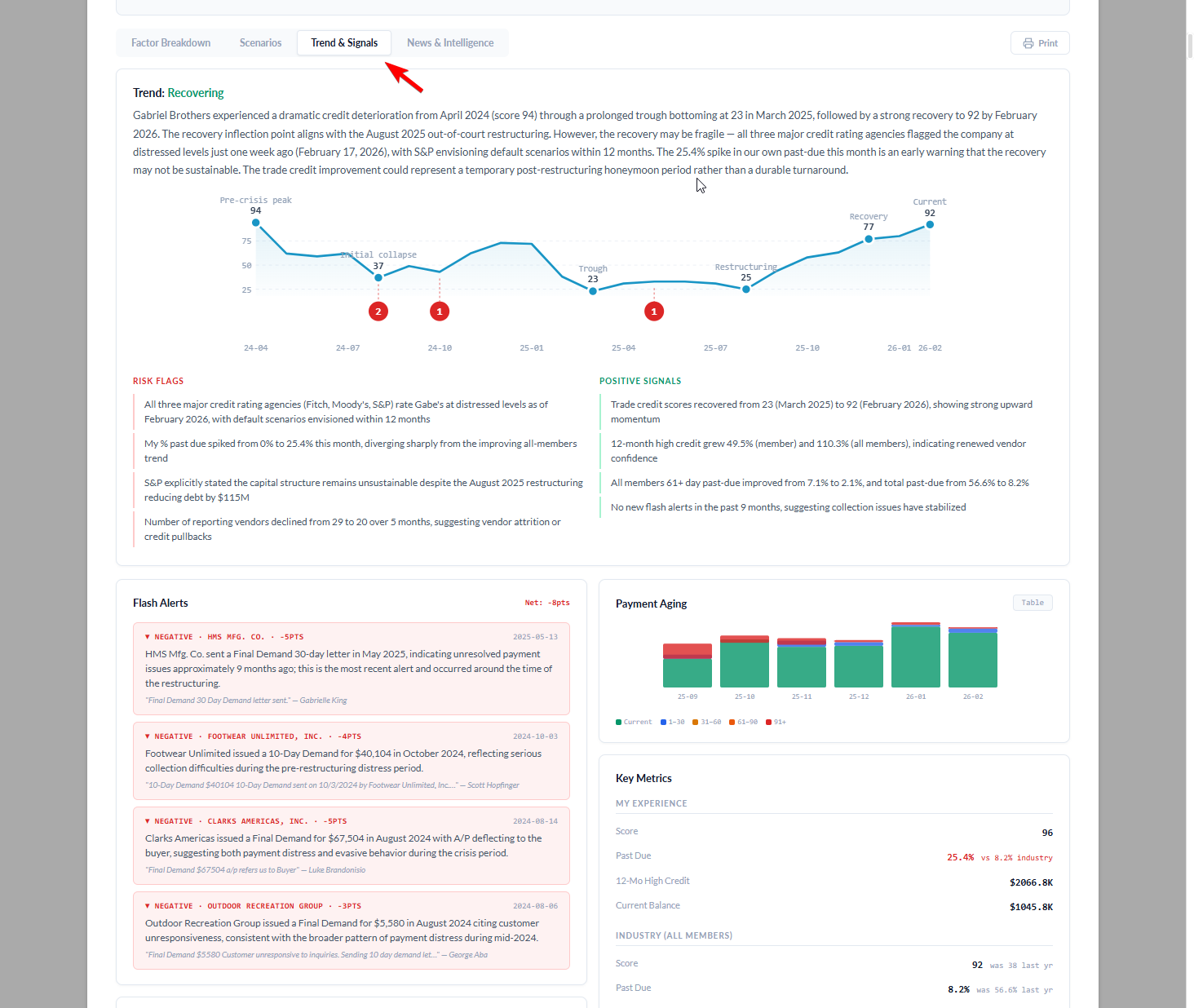
A 24-month score trajectory annotated with flash alerts, paired with risk flags and positive signals pulled from the underlying data.
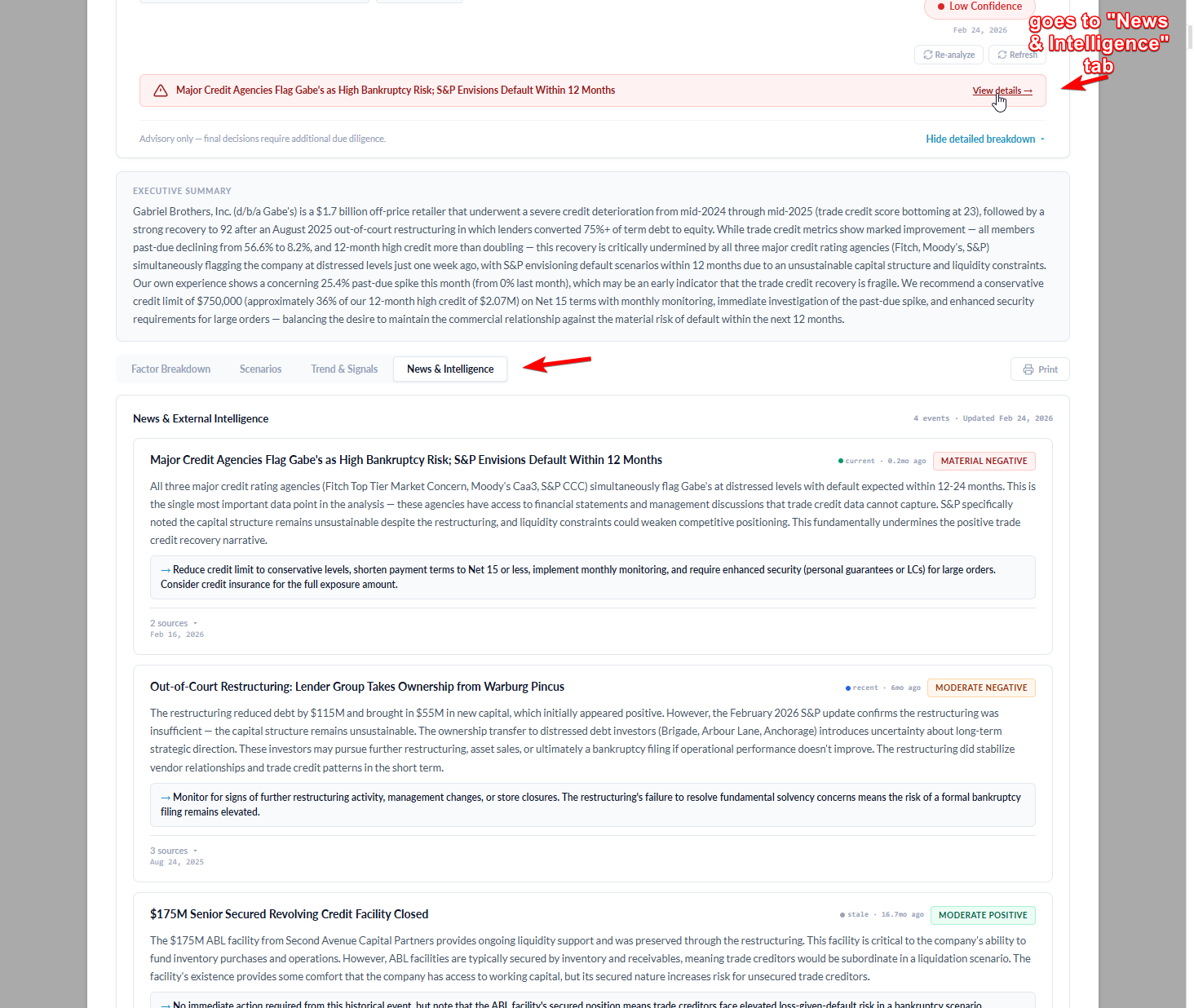
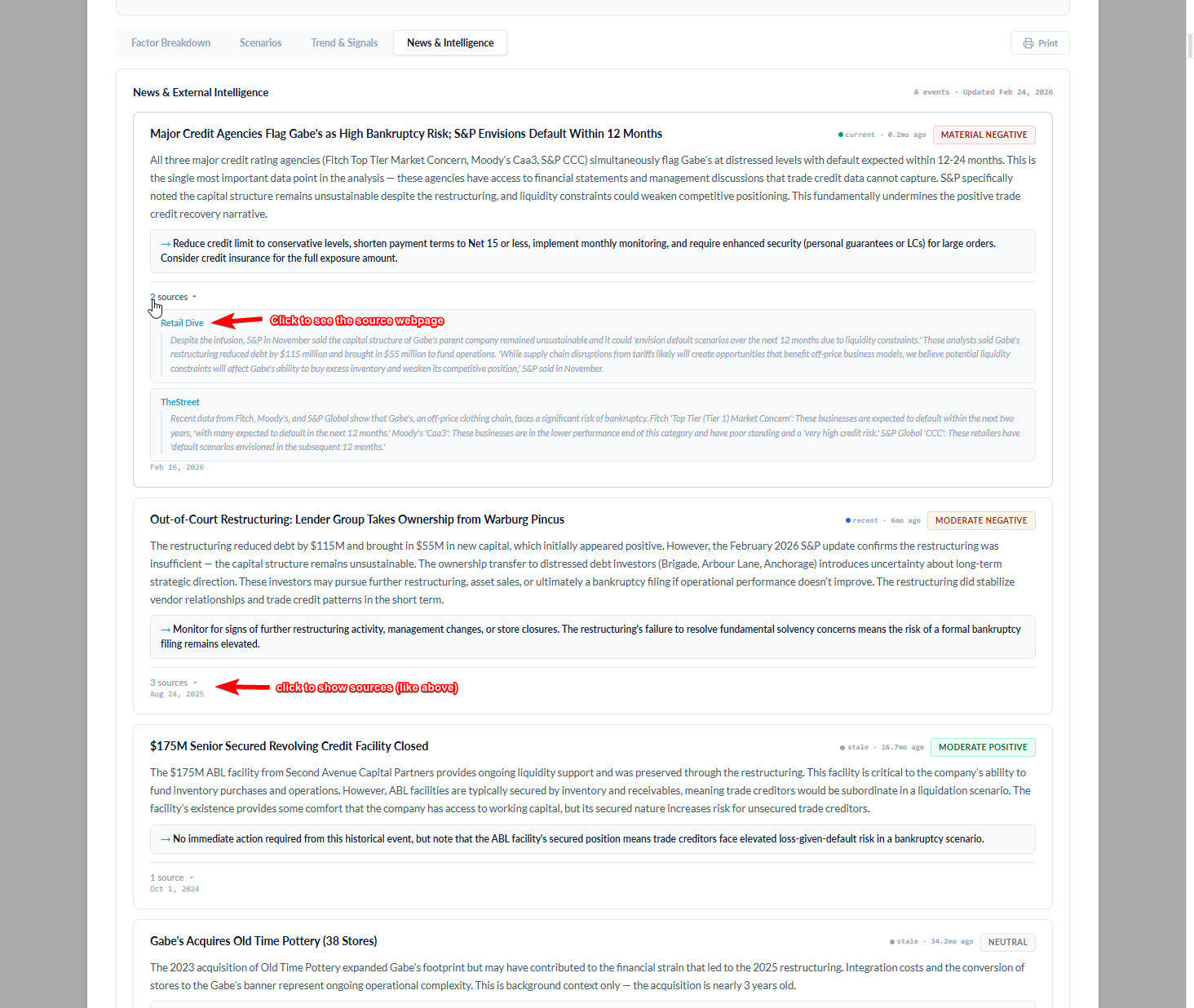
Sentiment-tagged news events with cited sources — so a material-negative article from Fitch or S&P is visible on the same page as the trade credit recommendation.
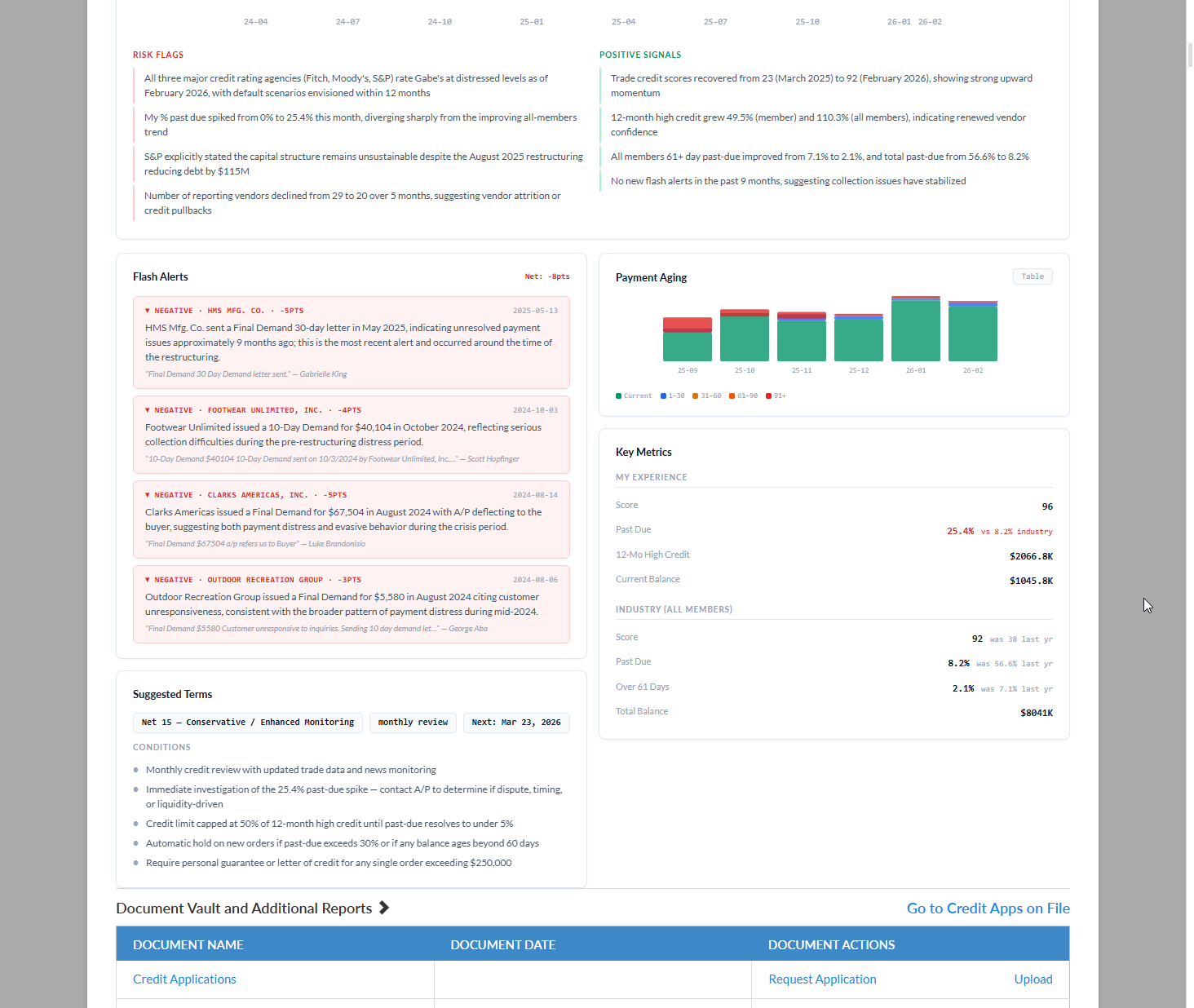
Flash alerts, payment aging, key metrics, suggested payment terms with conditions, and a document vault — all cross-linked to the reasoning above.
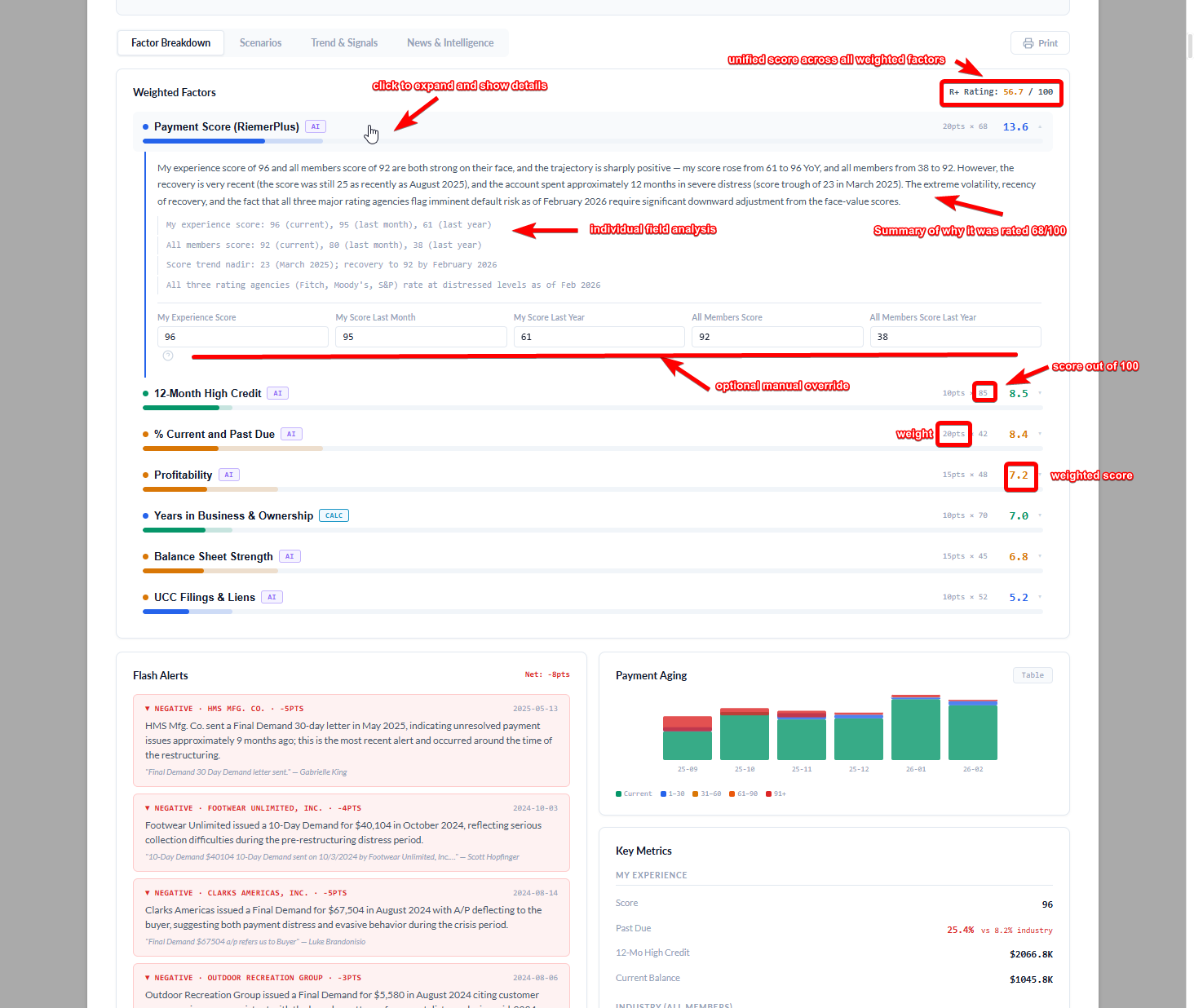
The headline rating isn't a number from a model nobody can audit. It's a weighted roll-up of seven factors — each scored independently, each explained in natural language, each overridable.
Every factor has a weight (in points), a score out of 100, and a weighted contribution to the final rating. Analysts can click any factor to expand the full AI-generated analysis, see the underlying fields the model looked at, and type their own override if they disagree.
Most credit models are opaque. This one is a receipt. If an analyst accepts the recommendation, they can defend it. If they override it, the override is captured alongside the original reasoning — and the next review cycle learns from it.
The system doesn't hand an analyst a single number and walk away. It proposes four credit lines — Restrictive, Conservative, Moderate, Aggressive — each tied to a specific set of conditions the business would need to accept.
One is flagged as the recommendation. The others are one click away. Each scenario includes an expected loss estimate, suggested payment terms, and the guardrails that would be required if the business chose to extend that much credit.
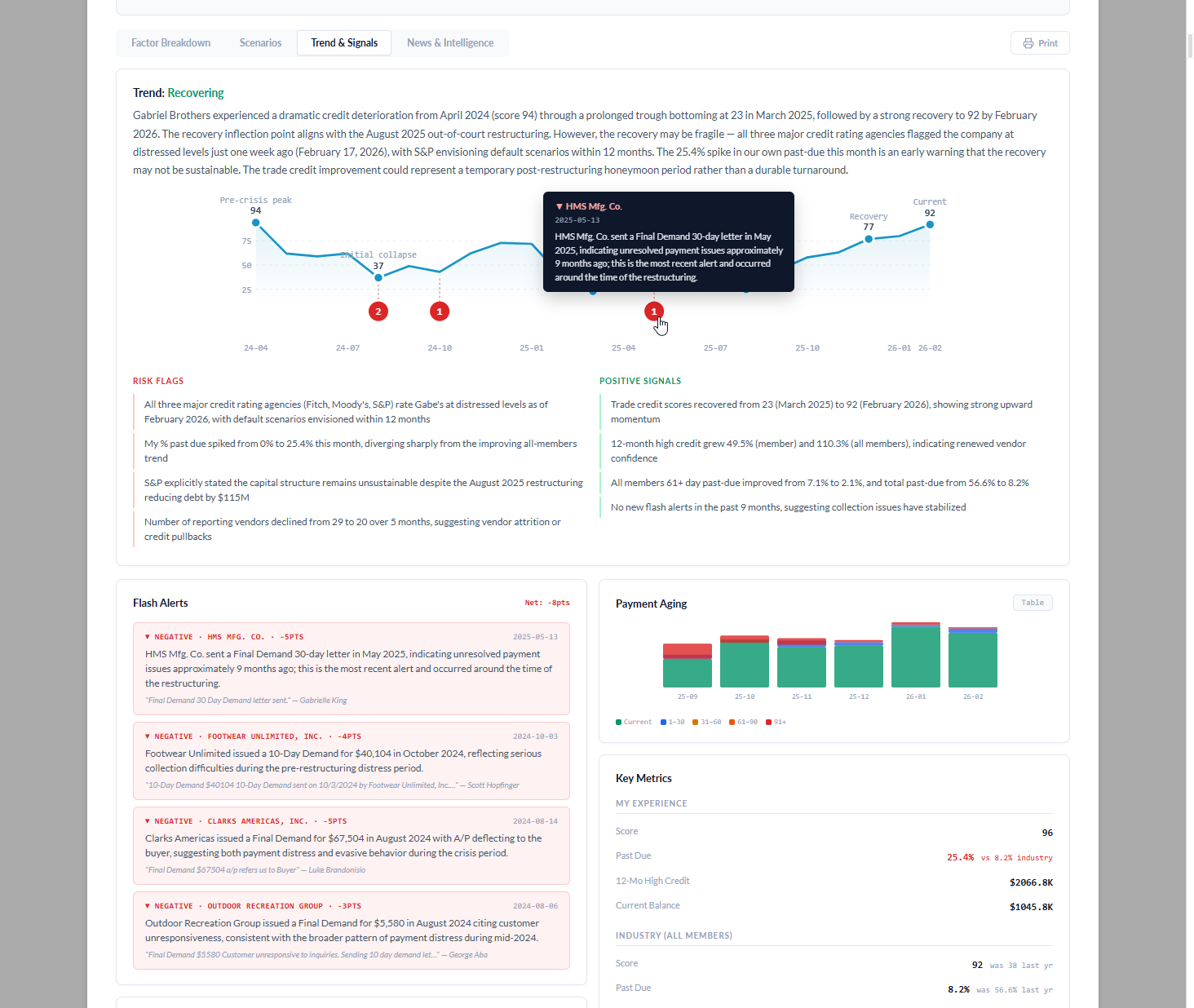
Credit risk is a trajectory. The Trend & Signals tab plots the account's trade credit score over the last two years, annotates every flash alert on the timeline, and pairs the chart with explicit risk flags and positive signals pulled from the same underlying data.
Every annotation on the chart is hover-expandable, linking back to the source alert. Risk flags and positive signals are generated from the live dataset — not from a report someone wrote six months ago.
Trade credit numbers tell you how a customer has paid you. They don't tell you Fitch just flagged the company as distressed. Our News & Intelligence agent pulls public news, rating agency actions, and material filings — classifies each event as positive, neutral, or negative — and summarizes what it means for the trade credit recommendation.
Every event is timestamped, sentiment-tagged, and cited. Analysts can expand the sources, read the original article, and see the specific sentence that triggered the alert.
Every scorecard closes with the paperwork: suggested payment terms, explicit conditions, flash-alert history, payment aging, and a document vault with direct links to the credit application and any supporting files on record.
The suggested terms aren't generic. They're generated from the selected scenario — so if the analyst switches from Conservative to Moderate, the suggested terms and conditions rewrite themselves accordingly.
The scorecard looks like one document. Behind it, a small choir of specialist AI agents each own a slice of the reasoning — and their outputs are stitched together into the final view by Alera's agent orchestration and flow optimization pipeline.
One agent per factor. Each one has a narrow job — score Payment, score Past Due, score Balance Sheet — and each one writes its reasoning in plain language so the output is auditable.
A research agent queries public news, rating agency releases, and filings, classifies each event, extracts the citation, and flags anything that contradicts the internal trade credit trend.
Given the factor scores and the news signal, a scenario agent produces four calibrated options — each with a dollar limit, expected loss, and set of conditions the business would need to accept.
A final flow composes the executive summary — the narrative that ties the R+ rating, the recommended line, and the dominant risk factor together into the first thing an analyst reads.
The whole pipeline runs on Alera — our AI-native platform. Agents invoke each other, flows version themselves, grading rubrics score the outputs, and the optimization pipeline improves the prompts over time without manual tuning.
per account — recommendation, reasoning, evidence, and terms in a single surface
to review a file, accept the recommendation, or override with captured rationale
scenario models per account — the trade-offs of each risk posture always visible
of recommendations cite their sources — every claim traceable to a field or article
The Credit Scorecard is one of many systems we've built for clients on Alera. If you've got a decision-heavy workflow that needs to collapse into a single, defensible surface, let's talk.