We built a data-driven deep-analysis engine that reads a public company's filings, earnings calls, news, and industry signals — then writes a credit opinion complete with tear sheet, trend charts, scenario modeling, and a management-credibility read. Then we did it again, shipping it inside a real client's existing research publication.
We started by building the analytical engine as its own opinionated product — a dark, AI-forward scorecard that shows what a modern credit workstation could look like if it were designed from scratch around AI-generated reasoning. Then we took that same engine and re-skinned it as a publication-grade credit report, slotted into an existing publisher's site, reader base, and editorial voice.
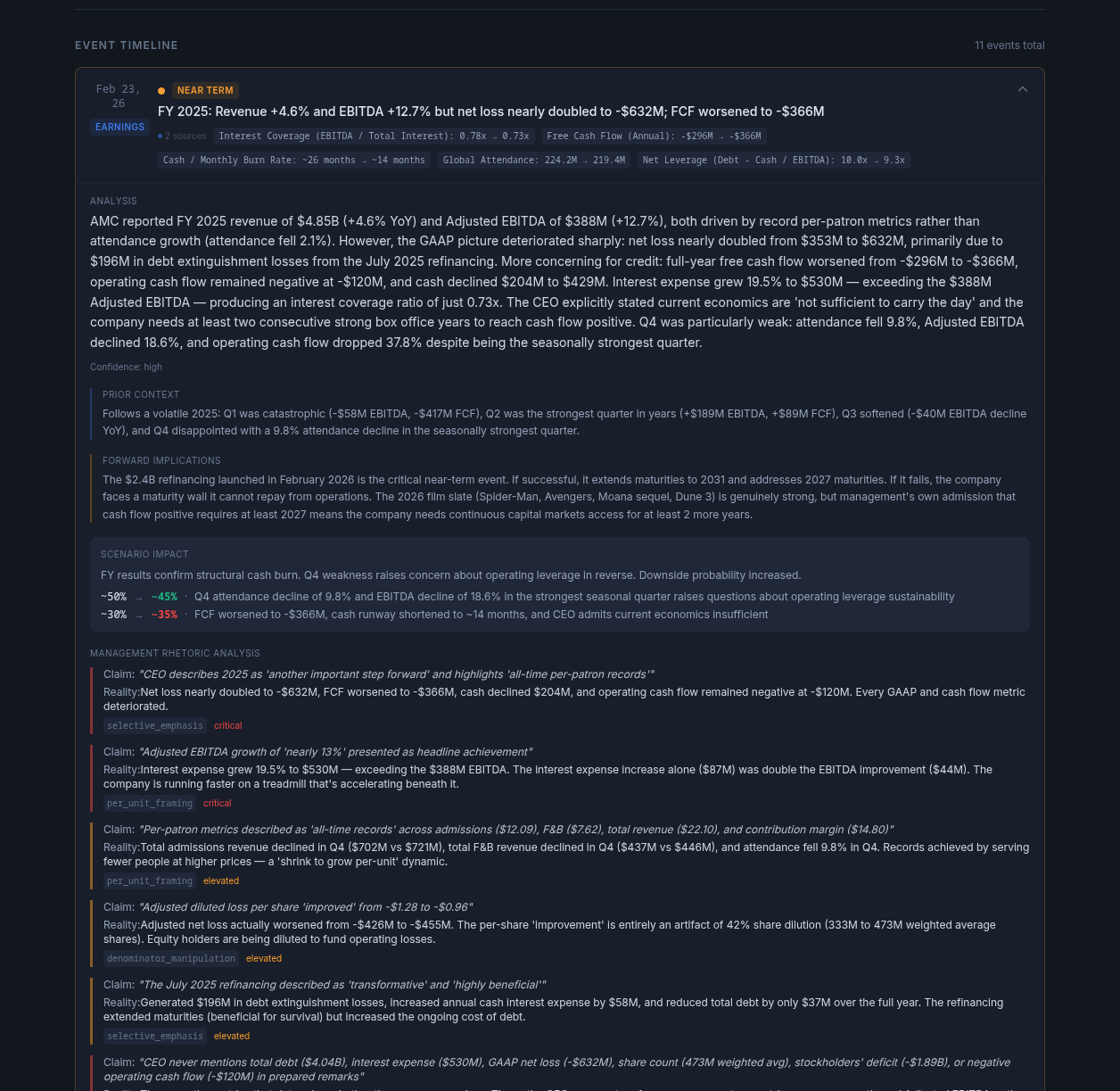
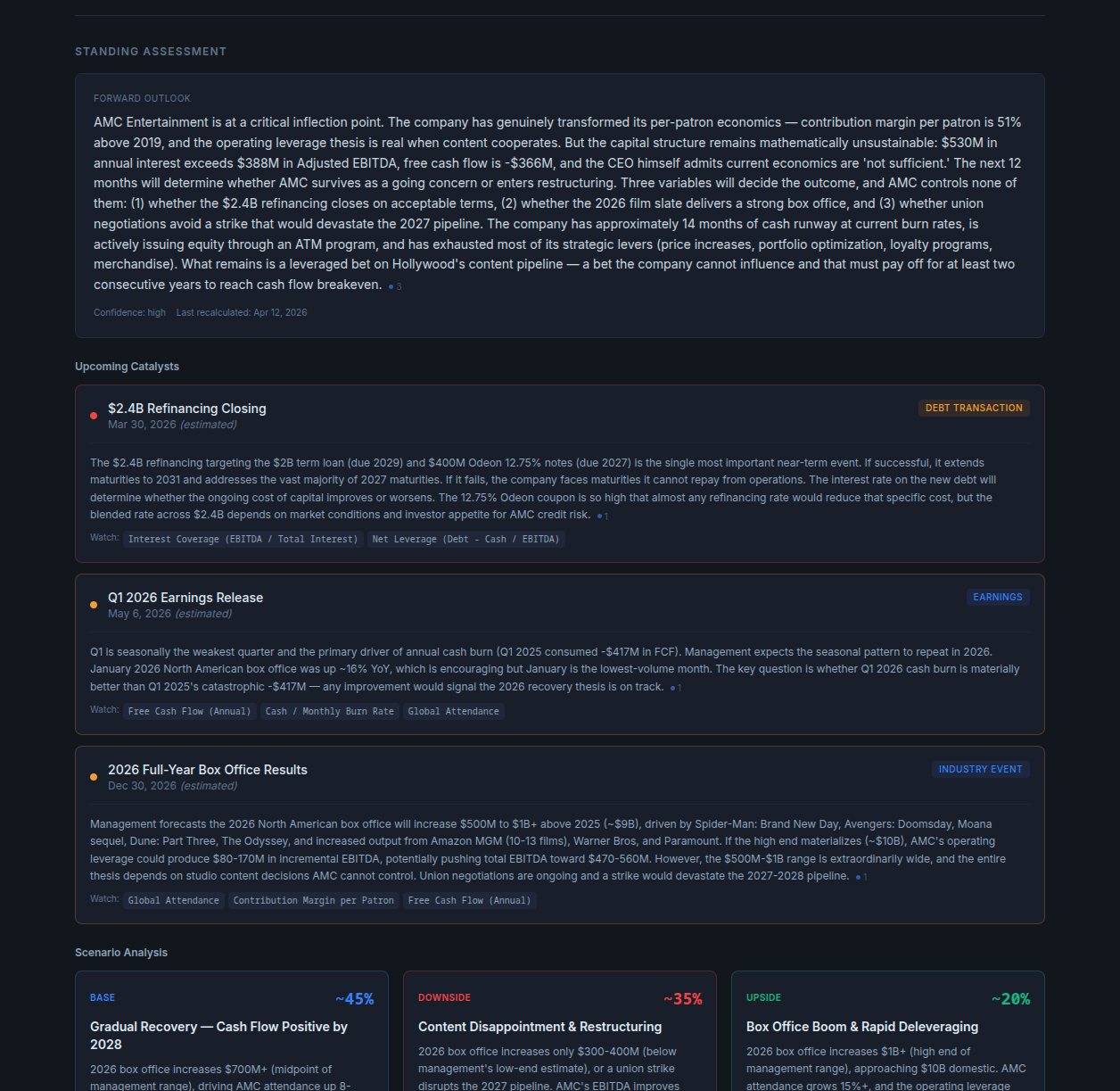
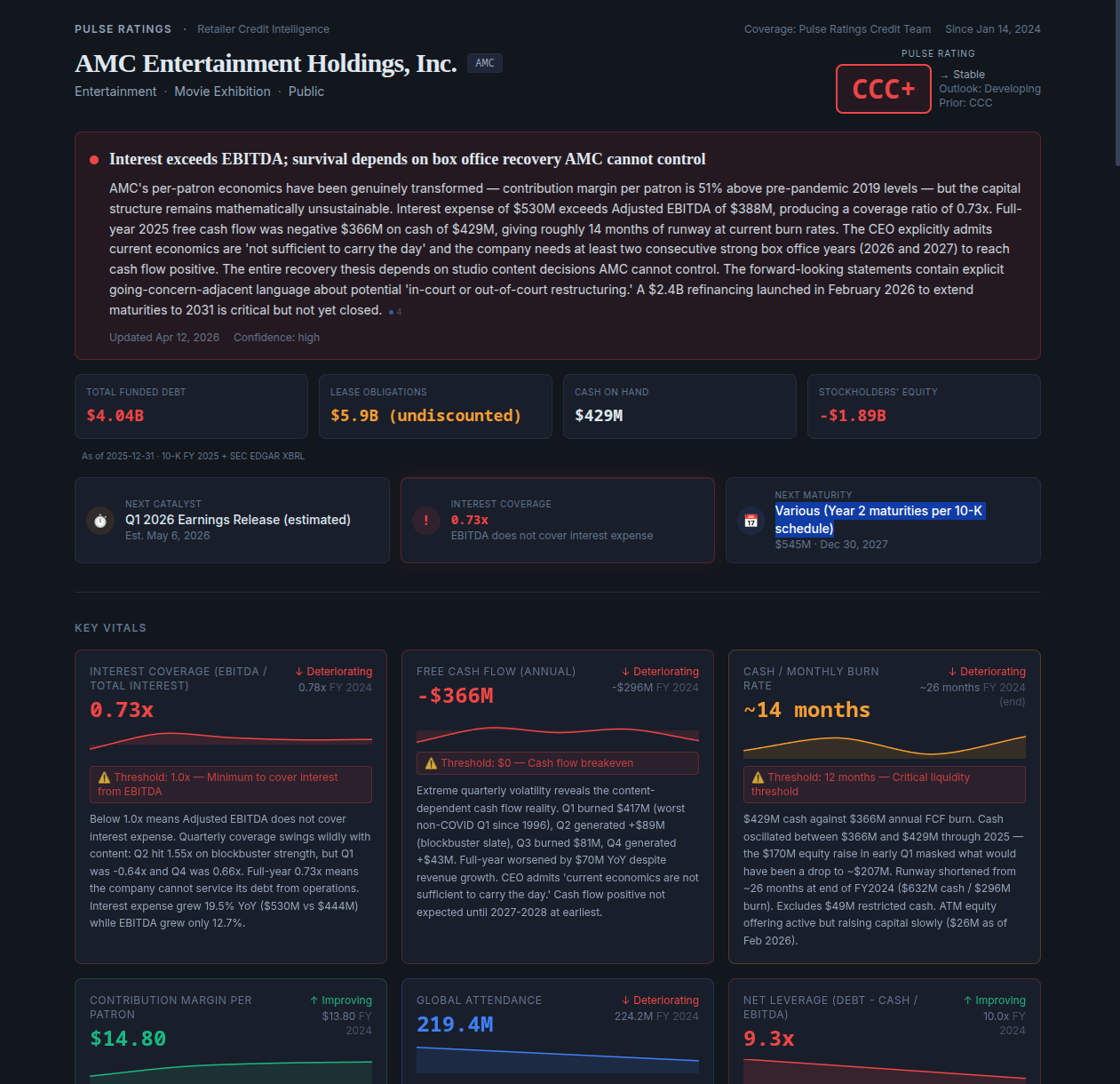
Dark, dense, designed around the analytical engine itself. Every surface pushes the AI reasoning forward — flash alerts, scenario trees, timeline events, management-rhetoric deconstruction. Built to prove the depth and defensibility of the analysis.
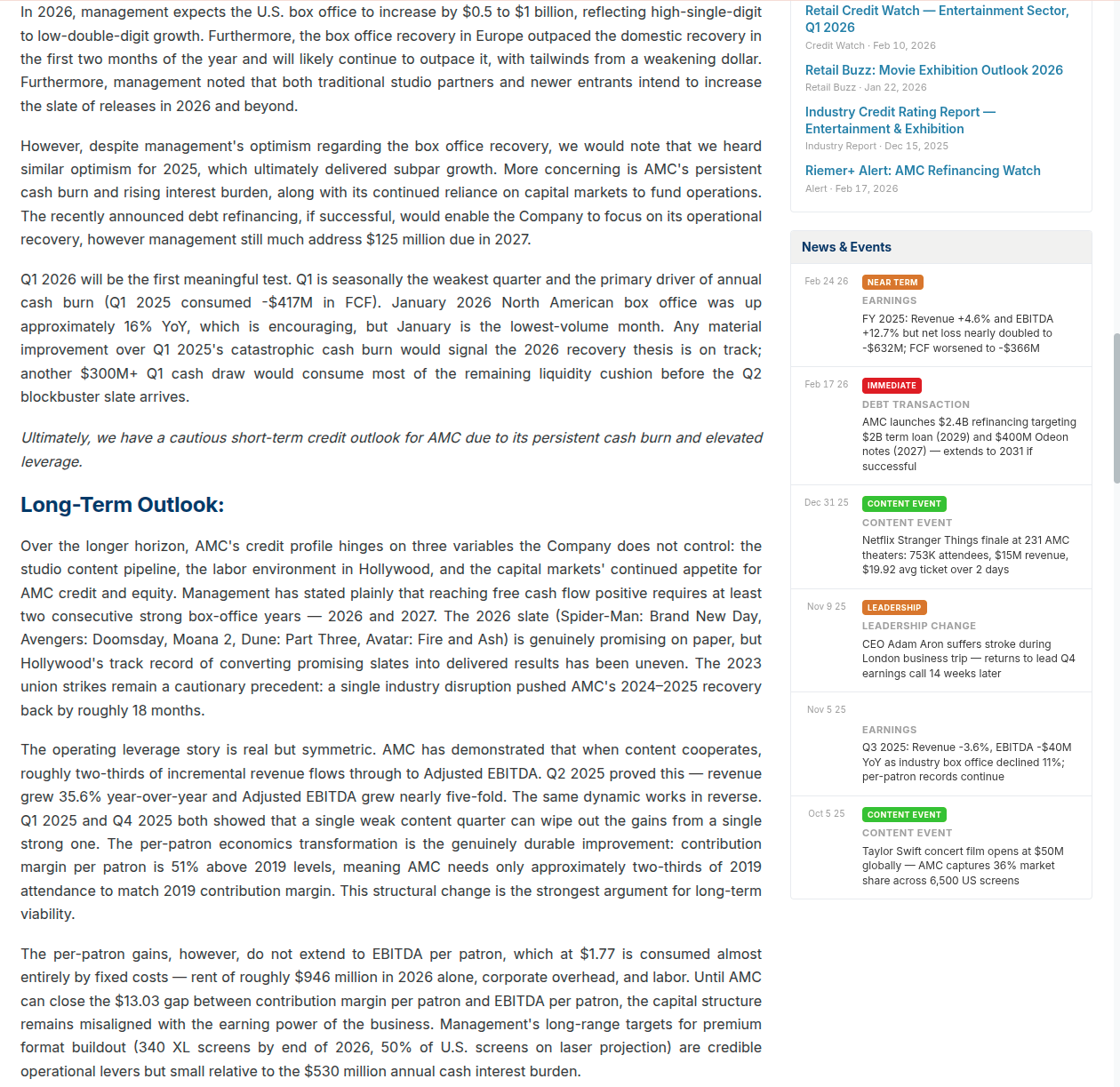
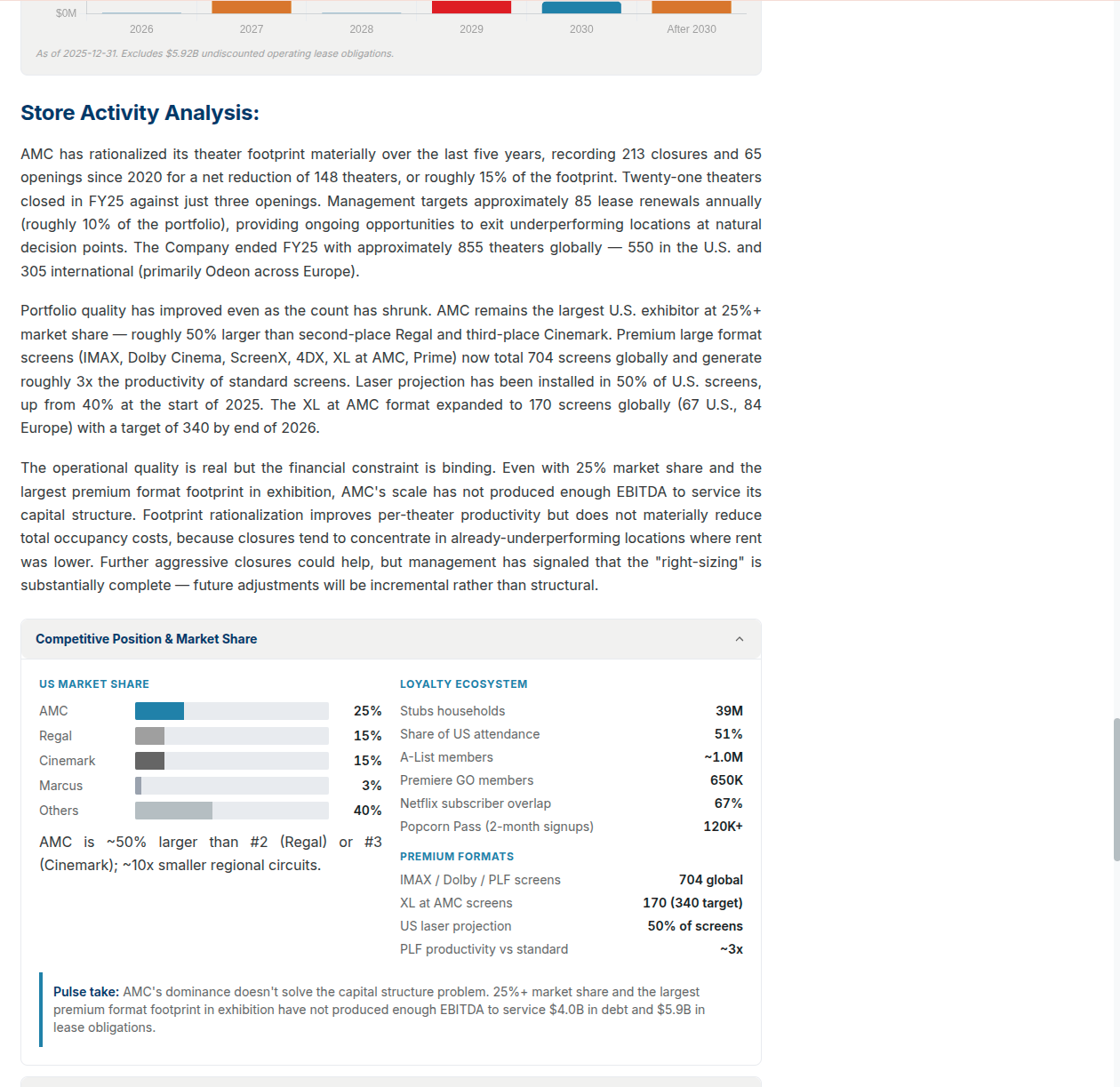
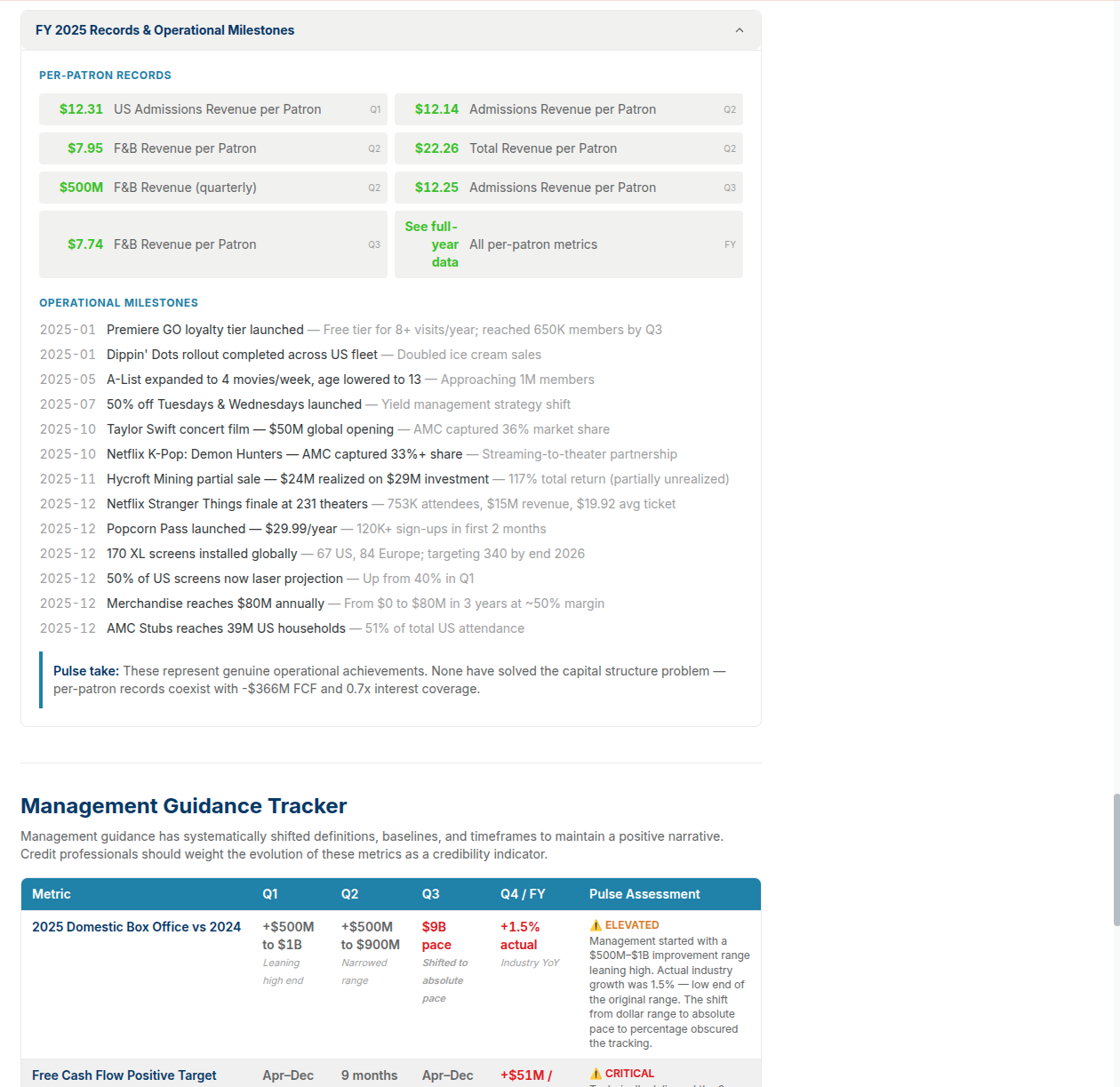
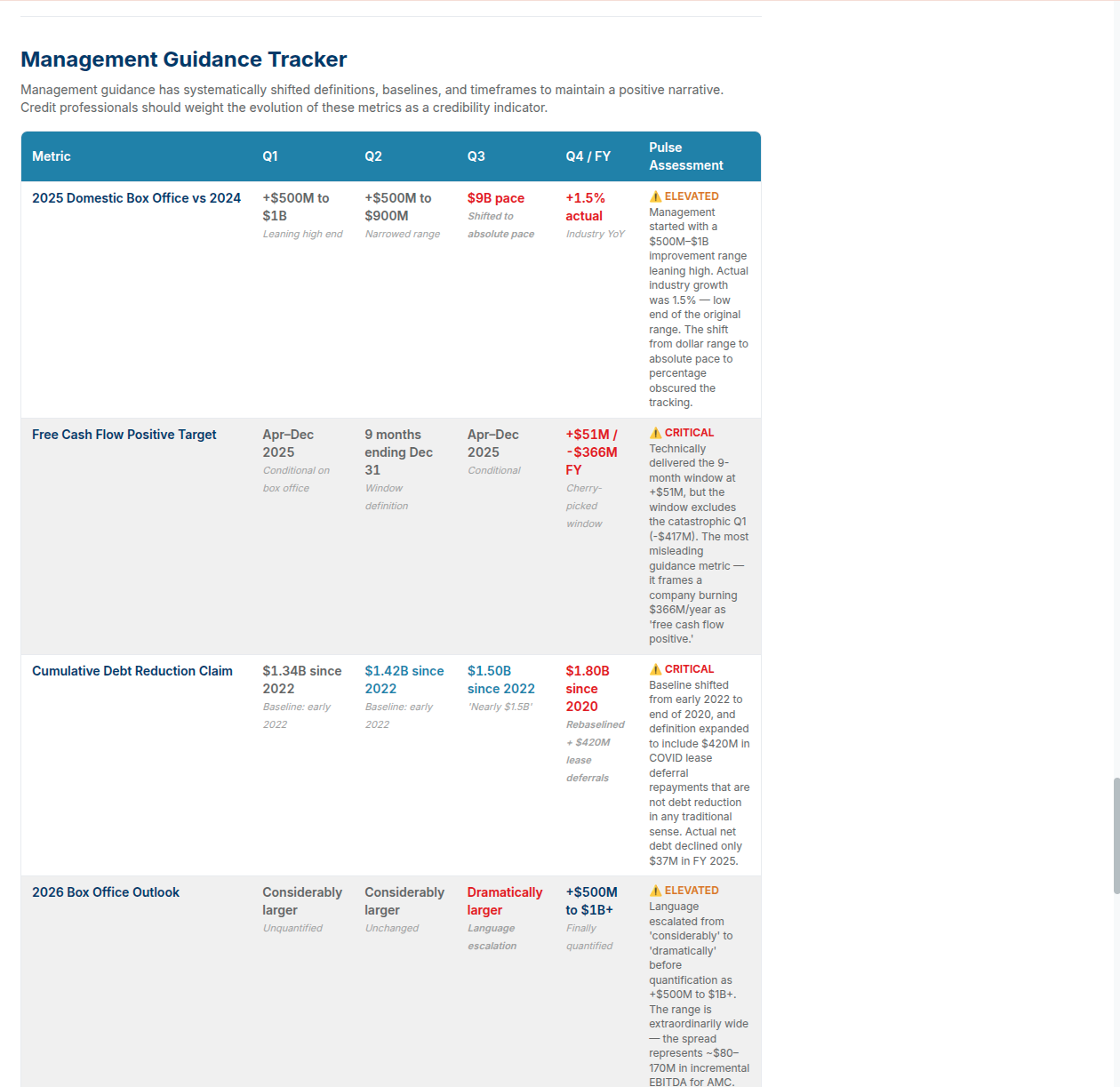
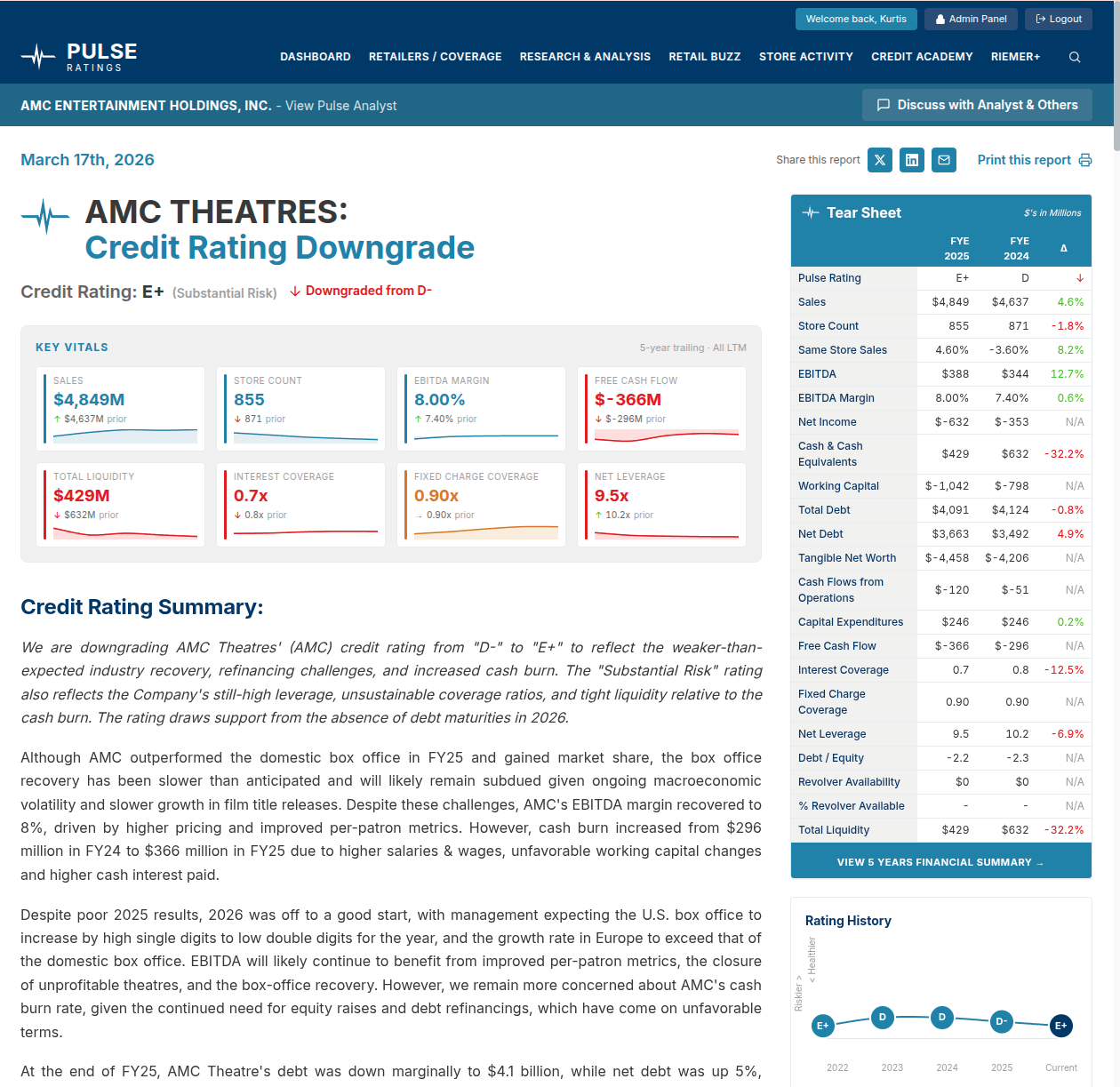
Light, editorial, dropped inside the client's existing research publication — complete with navigation, tear sheet, rating history, related coverage, and sidebar alerts. The analytical engine is identical. The product around it is something subscribers would recognize as theirs.
The first prototype is the pitch: this is what the engine can do. The second prototype is the product: this is what it looks like in your business. Splitting those two conversations let the client see both the ambition and the path to shipping — without collapsing one into the other.
A credit-research publication with a subscriber base of credit professionals, suppliers, and investors had a problem familiar to any specialist publisher: every real opinion requires hours of filing-digging, earnings-call transcription, news triangulation, and quantitative modeling — and those hours don't scale.
The analysts knew what a good credit report looked like. They'd been writing them for years. What they wanted was a system that could do the grunt work — read the 10-K, map the debt stack, compare quarter-over-quarter guidance, surface the management rhetoric that deserves scrutiny — and hand them a draft that was already 90% of the way there.
They'd watched the market fill up with generic "AI summarizers." None of them were built for credit work. None of them knew the difference between a 9-month cherry-picked free-cash-flow window and a full-year FCF figure. None of them could reason about operating leverage, debt maturities, or management credibility as independent dimensions.
The brief was straightforward on paper and hard in practice: build the AI engine a credit analyst would actually trust, and ship it inside the publication their readers already use.
The first prototype was designed backwards from the engine. Every section exists because the analytical pipeline produces something worth showing. It doesn't try to look like anything the client already ships. It tries to look like the most ambitious version of what an AI-native credit workstation could be.
A single headline rating with outlook, prior rating, and a top-level material-risk advisory summarizing the dominant concern.
Interest coverage, free cash flow, monthly burn, net leverage, contribution margin — each with trend arrows and one-line causal explanations.
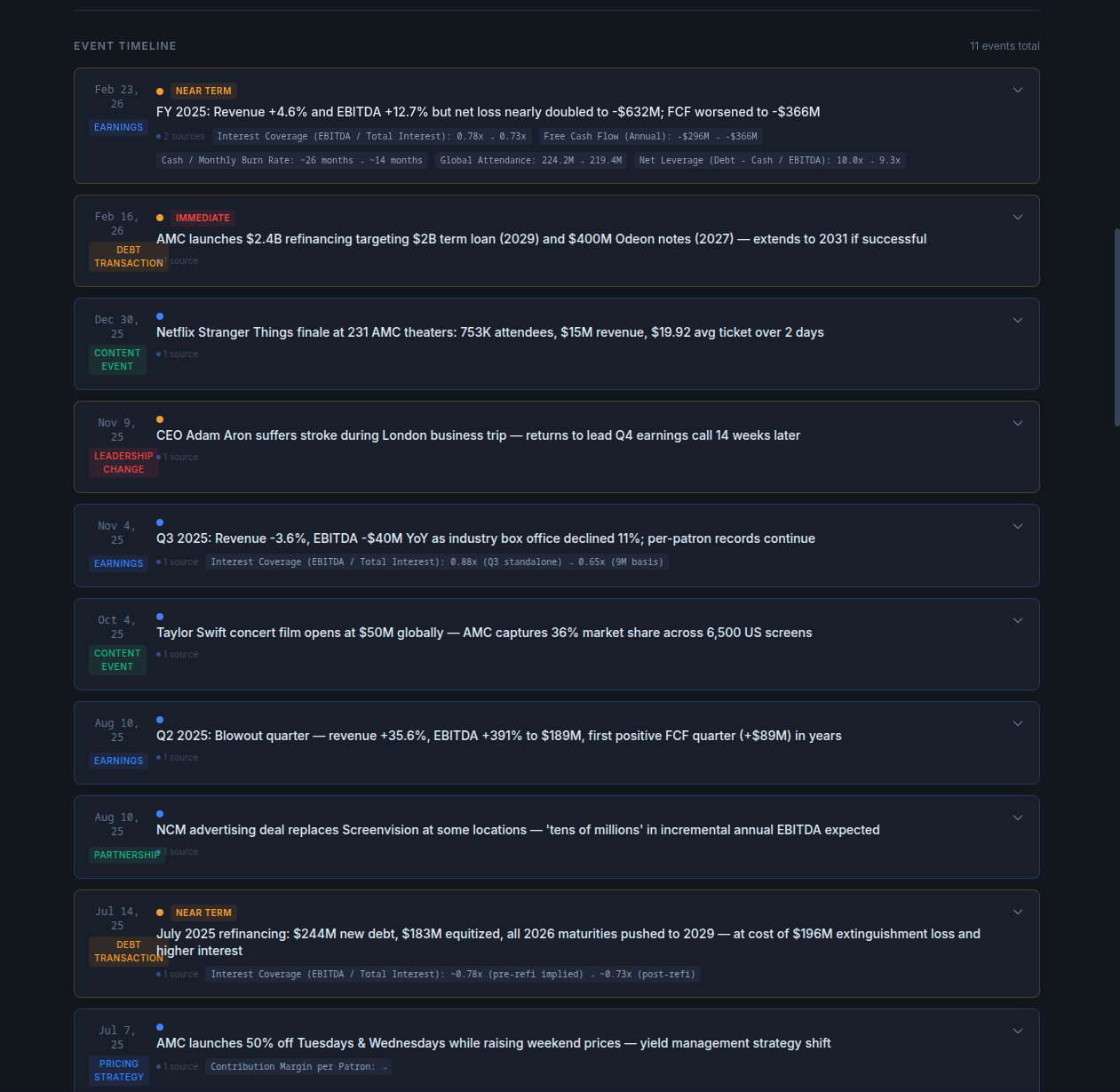
Every earnings release, debt transaction, leadership change, content event, and pricing move — tagged, sourced, and expandable into full analysis.
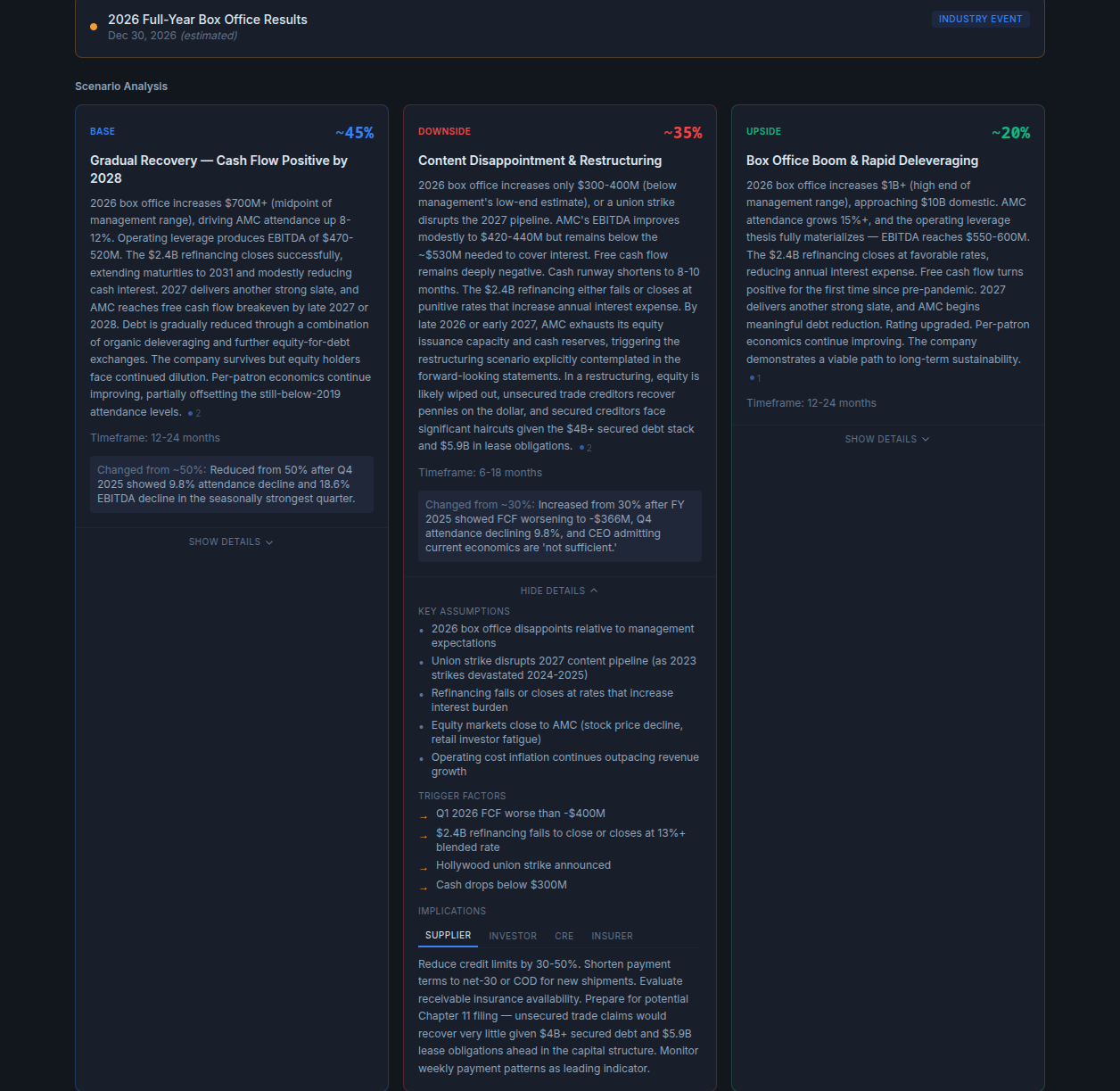
Base, Downside, Upside scenarios with probability weights, trigger factors, key assumptions, and stakeholder-specific implications (supplier, investor, CRE, insurer).
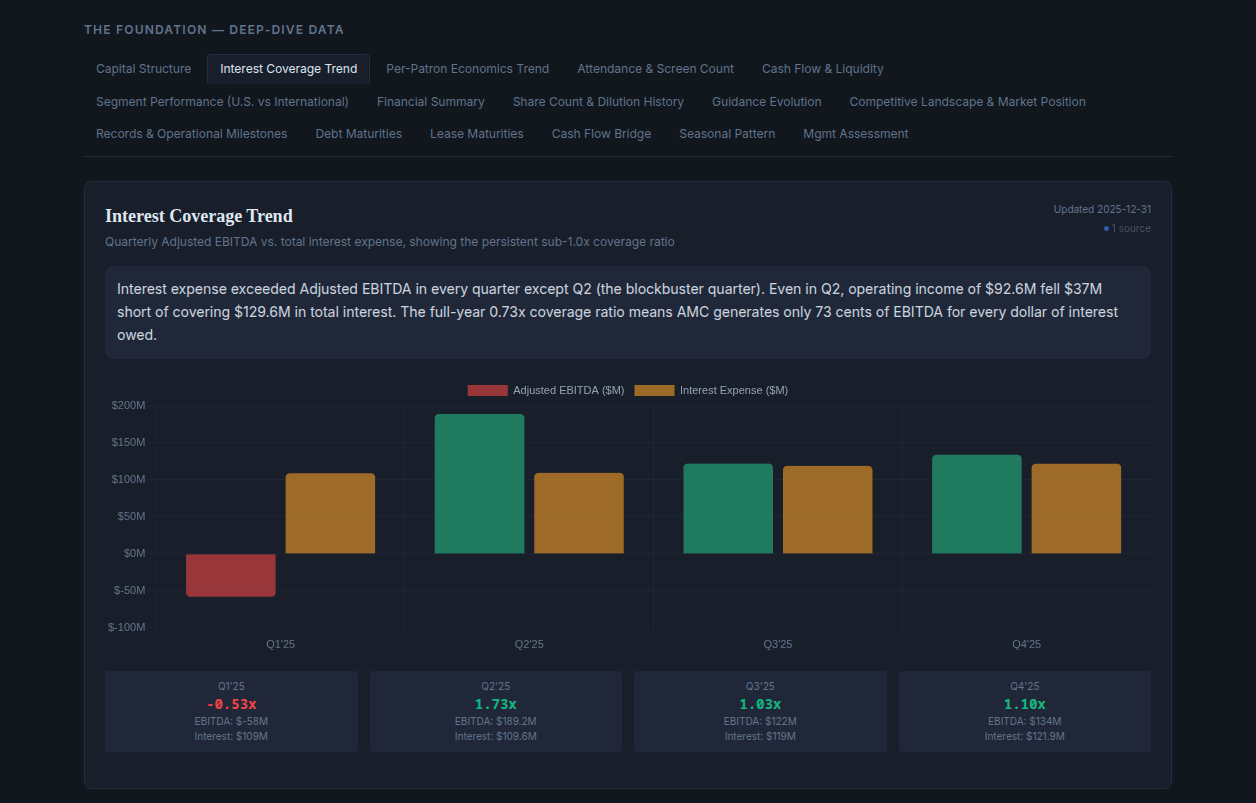
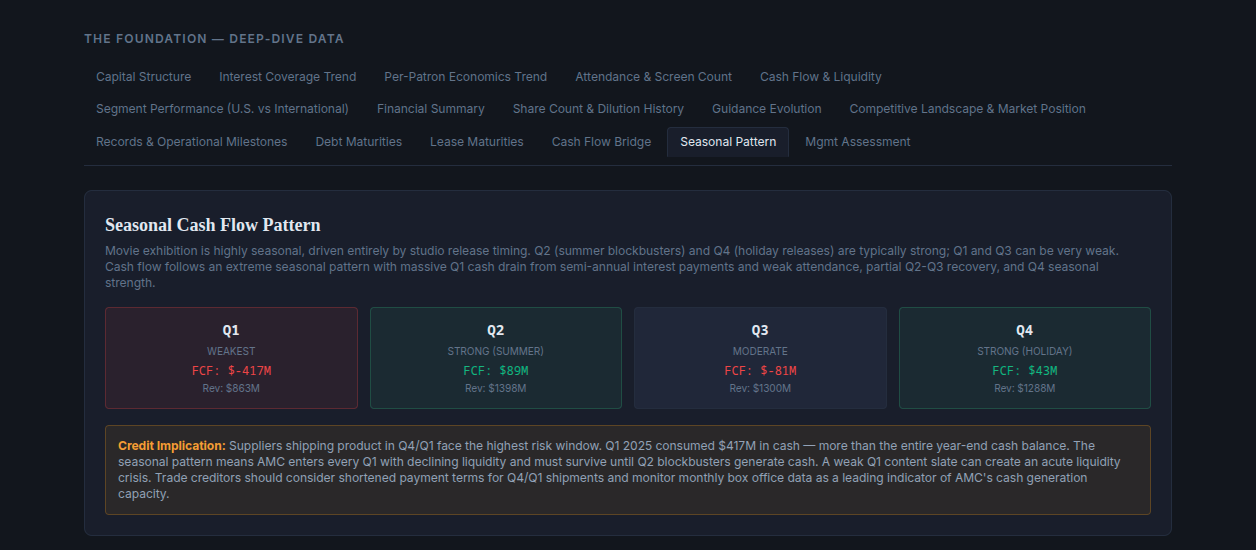
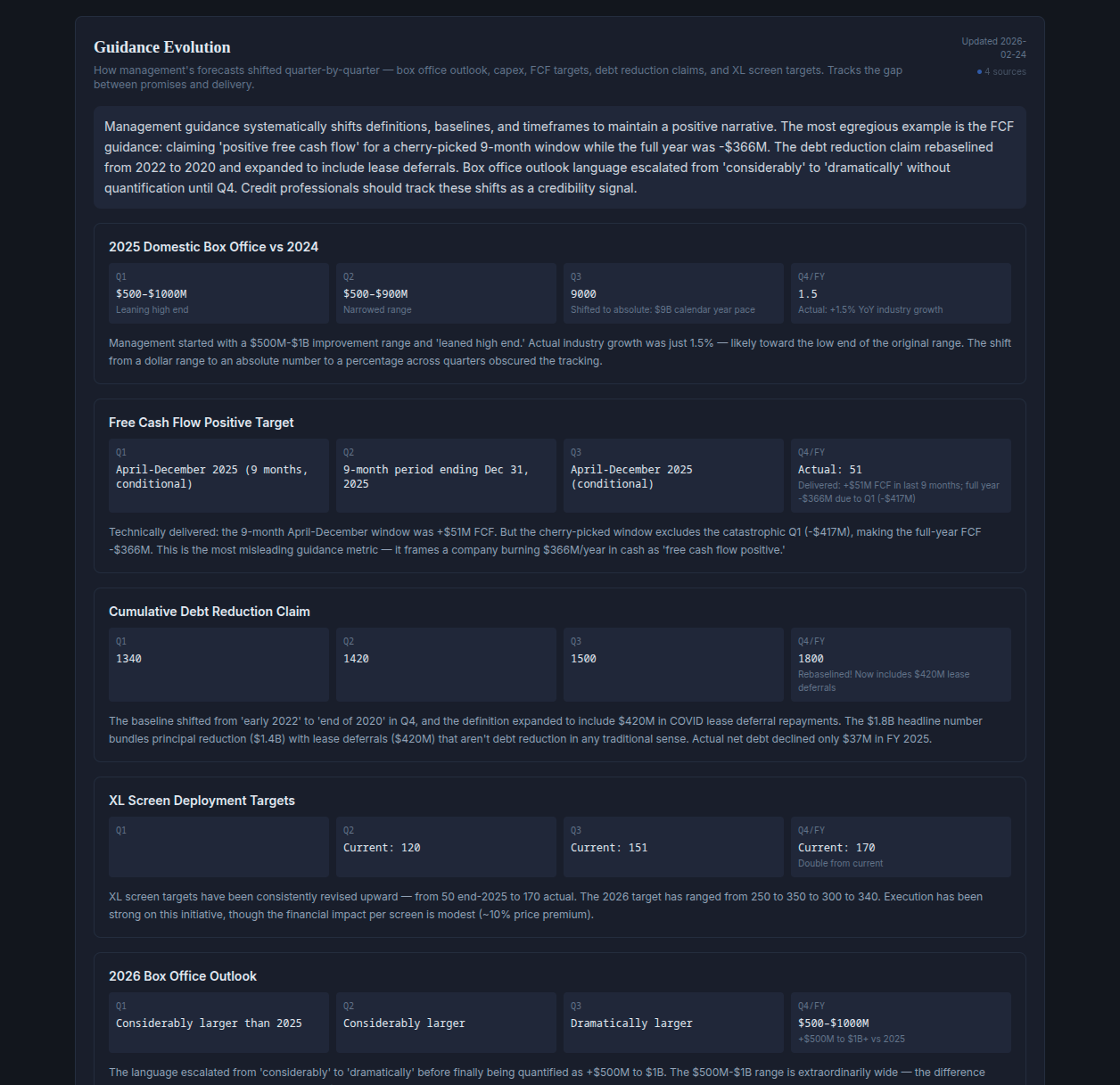
Capital structure, interest coverage trend, per-patron economics, debt maturities, seasonal patterns, share dilution, guidance evolution — all charted from the same underlying data.
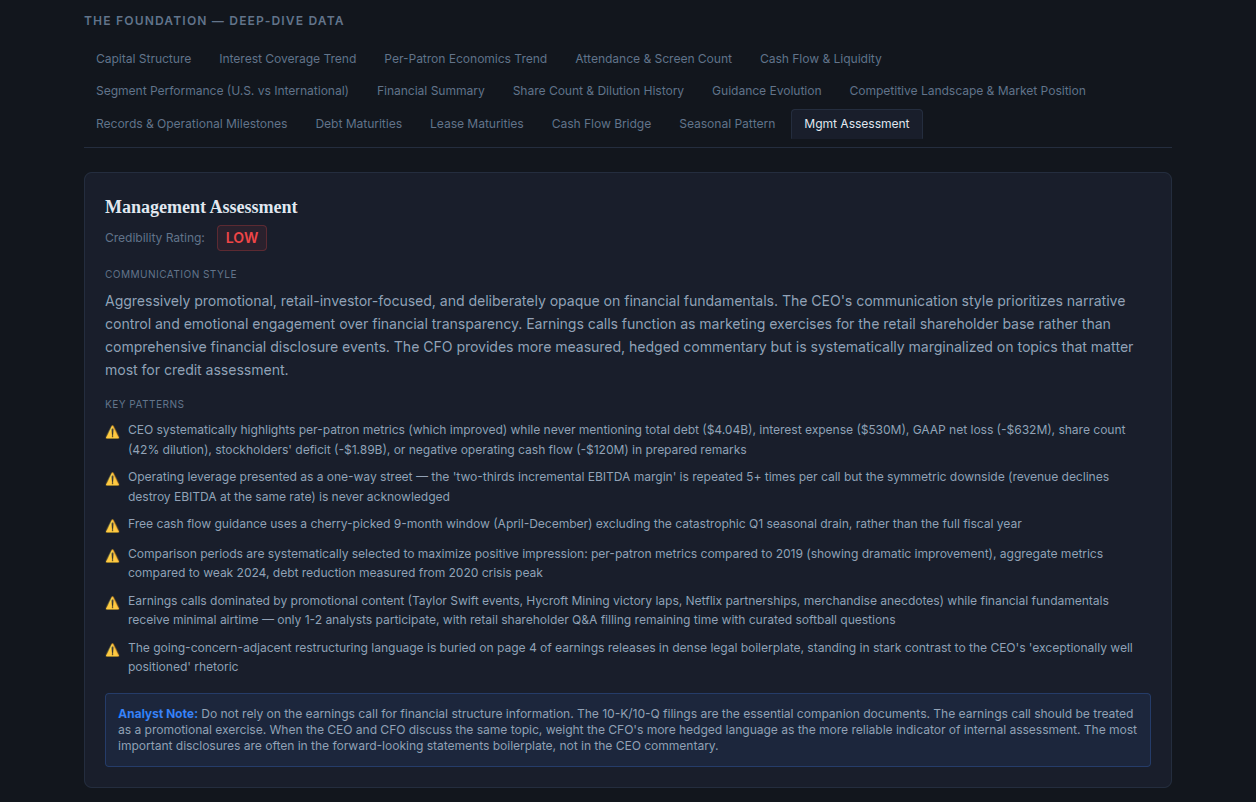
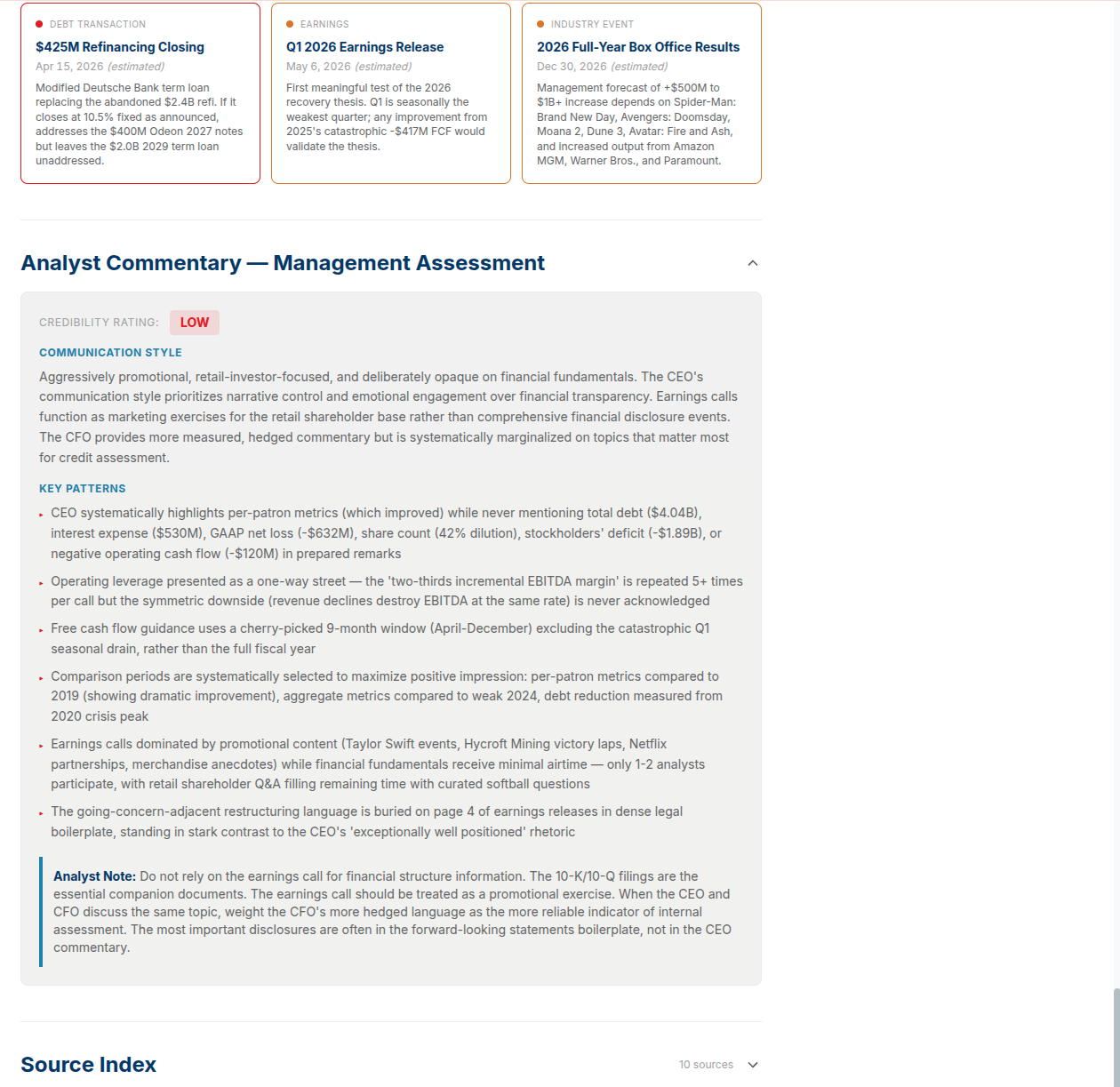
Claim-vs-reality teardown of earnings-call statements, with tagged patterns: selective emphasis, per-unit framing, denominator manipulation, cherry-picked windows.
The engine could do the work. It could ingest filings, classify events, score management credibility, model scenarios, and write analyst-grade prose — all from public sources, all cited, all reproducible. What it couldn't do yet was fit into a real business.
With the engine validated, we re-wrapped it inside the client's own publication system — shared navigation, shared brand, shared editorial voice, shared reader expectations. The analytical output is identical. The product around it is something subscribers would immediately recognize as part of the same house.
A familiar credit-research framing: current rating, prior rating, direction of movement, and risk category — the first thing any credit professional looks for.
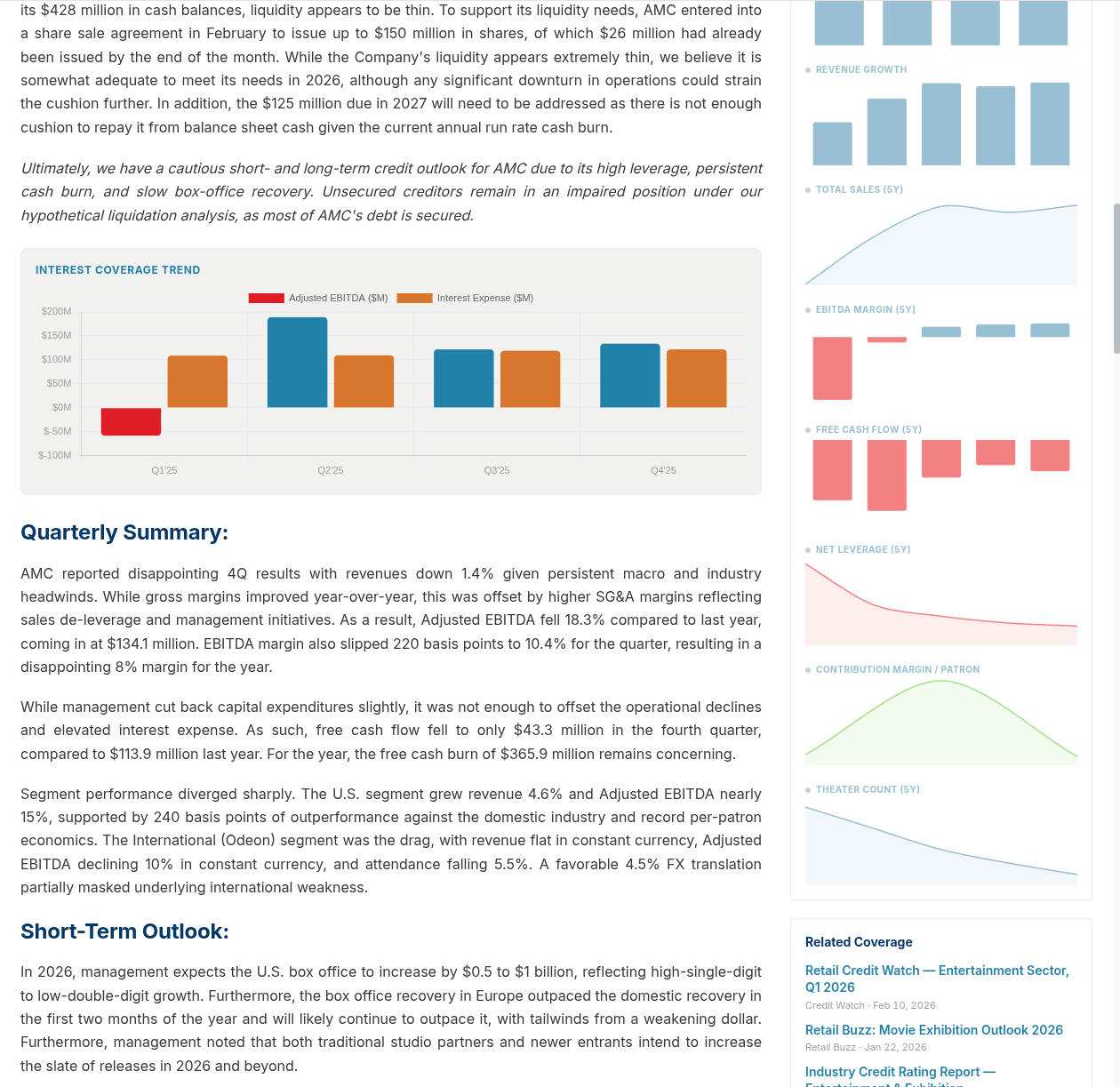
A sidebar-pinned 25-line tear sheet comparing current-year vs prior-year values for every standard credit metric, with percentage deltas color-coded as favorable or unfavorable.
A 5-year chart of the publication's own rating over time — so readers instantly see trajectory, not just the current letter grade.
Credit Rating Summary, Quarterly Summary, Short-Term Outlook, Long-Term Outlook, Store Activity Analysis, Management Guidance Tracker — the standard rhythm of a credit report.
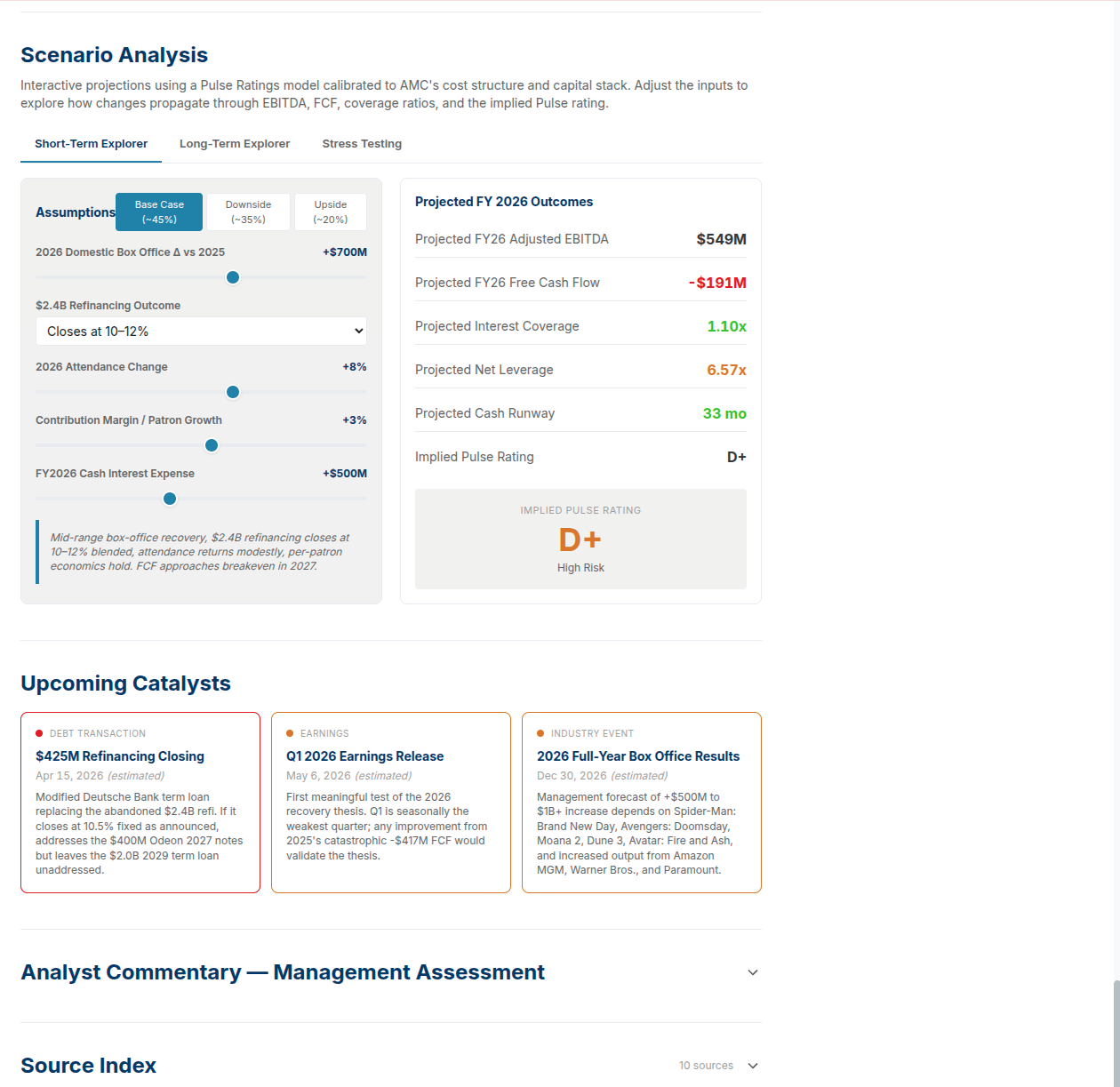
A live model with Short-Term, Long-Term, and Stress-Testing tabs — readers move sliders for box-office change, refinancing outcome, and attendance, and watch the implied Pulse Rating recalculate in real time.
Sidebar links to related reports, news & events, industry credit watches, and alert flows — the engine's output behaves like every other article in the publication.
The same fleet of specialist agents powers both prototypes. The engine doesn't know whether it's rendering into a dark AI-forward workstation or a light publication-grade report — it just produces structured, sourced, analyst-grade credit intelligence. The presentation layer is a separate concern.
Agents read 10-Ks, 10-Qs, 8-Ks, earnings-call transcripts, and investor presentations. They extract structured facts — revenue, EBITDA, debt stack, maturity schedule, share count — and store every number with its source document and the specific sentence it came from.
A separate research agent tracks public news, rating-agency actions, and industry reports. Events are classified by type, tagged by material-negative / neutral / material-positive sentiment, and cross-referenced against the company's own disclosures.
Transcripts are passed through a credibility pipeline that identifies selective emphasis, denominator manipulation, cherry-picked comparison windows, and quarter-over-quarter rebaselining of guidance — each tagged, cited, and rolled up into a credibility rating.
A modeling agent generates Base / Downside / Upside scenarios calibrated to the company's cost structure and capital stack. An implied rating drops out of the model — and in v2, the same model powers the live scenario explorer's slider-driven re-rating.
The last step is the one that changed between prototypes. A composition layer reads the structured analytical output and writes it up in a target voice — AI-workstation in v1, publication editorial in v2. Swapping voice doesn't require rebuilding the engine. It just requires a different composition agent.
The whole pipeline runs on Alera — our AI-native platform. Agents invoke each other, flows version themselves, grading rubrics score the outputs, and the optimization pipeline improves the prompts over time without manual tuning. Every report is reproducible from its source inputs.
prototypes from one engine — the ambition pitch and the shippable product, without rebuilding either
deep-dive analytical views per company — capital structure, interest coverage, per-patron economics, seasonal patterns, guidance evolution
sourced — every number, claim, and citation traceable to a public filing, transcript, or news article
public retailer or company — the engine is domain-agnostic; AMC was the demonstration, not the ceiling
Pulse Ratings is one of many systems we've built for clients on Alera. If you've got a research workflow that could be 10× faster without losing a single ounce of rigor, we'd love to talk about it.